


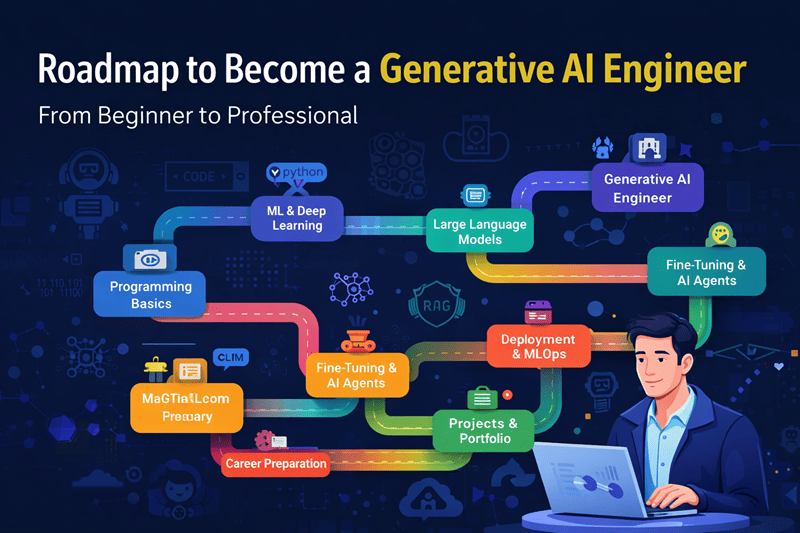
🚀 Roadmap to Become a Generative AI Engineer: From Beginner to Professional
Generative AI is one of the fastest-growing fields in technology, powering applications that can generate text, images, audio, video, and even code. Becoming a Generative AI Engineer requires a combination of programming, machine learning, system design, and real-world implementation skills.
This step-by-step roadmap will guide you through the complete journey—from beginner fundamentals to becoming a job-ready AI professional.
🎯 What Does a Generative AI Engineer Do?
A Generative AI Engineer builds, fine-tunes, deploys, and maintains intelligent systems capable of generating content. This role combines:
- Software Engineering
- Machine Learning & Deep Learning
- AI System Design
- Deployment & MLOps
It’s not just about using AI tools—it’s about understanding, building, and scaling real-world AI systems.
🧭 Phase 1: Programming, Math & Computer Science Foundations
Every strong AI engineer starts with solid fundamentals. This phase builds the foundation needed to understand how AI systems work internally.
🔹 Key Skills
- Python programming
- Data structures and algorithms
- Linear algebra
- Probability and statistics
- Object-oriented programming
🔹 Tools
- Python, NumPy, Pandas
- Jupyter Notebook
- Git & GitHub
🎯 Goal
Develop strong coding skills and mathematical intuition to understand how models work rather than treating them as black boxes.
🧠 Phase 2: Machine Learning & Deep Learning
This phase introduces how machines learn from data and how neural networks operate.
🔹 Key Skills
- Supervised & unsupervised learning
- Neural networks, CNNs, RNNs
- Model evaluation & optimization
- Overfitting and regularization
🔹 Tools
- PyTorch, TensorFlow, Keras
- Scikit-learn
- Google Colab
🎯 Goal
Learn how to train, evaluate, and optimize models using real datasets.
🤖 Phase 3: Generative AI & Large Language Models
This is where you enter the core of Generative AI—understanding how modern AI systems generate content.
🔹 Key Skills
- Transformer architecture
- Attention mechanisms
- Tokenization & embeddings
- Prompt engineering
- Multimodal generation
🔹 Tools
- Hugging Face Transformers
- OpenAI / Gemini APIs
- LLaMA, Mistral
- Diffusion models
🎯 Goal
Understand how LLMs work and build basic AI-powered applications.
⚙️ Phase 4: Fine-Tuning, RAG & AI Agents
Now you move from using models to customizing them for real-world use cases.
🔹 Key Skills
- Fine-tuning techniques (LoRA, QLoRA)
- Retrieval-Augmented Generation (RAG)
- Vector databases
- AI agents & tool usage
🔹 Tools
- FAISS, Pinecone, Chroma
- LangChain, LlamaIndex
- Embedding models
🎯 Goal
Build accurate, reliable AI systems using external knowledge and tools.
🛠️ Phase 5: GenAI Application Development
This phase focuses on building complete AI applications.
🔹 Key Skills
- Backend development & APIs
- Frontend basics
- System design
- UI for AI applications
🔹 Tools
- FastAPI, Flask
- Streamlit, Gradio
- REST APIs
🎯 Goal
Create end-to-end applications that users can interact with.
☁️ Phase 6: Deployment, MLOps & Career Readiness
Here you learn how to deploy and manage AI systems in production environments.
🔹 Key Skills
- Model deployment
- Monitoring & logging
- Security and cost optimization
- Technical communication
🔹 Tools
- Docker
- Cloud platforms
- CI/CD pipelines
🎯 Goal
Become job-ready by building scalable, production-level AI systems.
🧩 Phase 7: Projects & Portfolio
Your portfolio is your proof of skill. This phase focuses on building real-world projects.
🔹 Key Activities
- Build end-to-end AI applications
- Solve real-world problems
- Document your work
- Publish projects online
🔹 Tools
- GitHub
- Hugging Face Spaces
- Kaggle
- Streamlit / Gradio
🎯 Goal
Showcase your skills to recruiters with practical projects.
🎯 Phase 8: Career Preparation & Specialization
Now it’s time to position yourself in the job market.
🔹 Key Skills
- Technical interview preparation
- System design
- Communication & storytelling
- Domain specialization
🔹 Specialization Options
- LLM Engineer
- AI Agent Engineer
- Multimodal AI Engineer
- GenAI Platform Engineer
- Applied AI Research Engineer
🎯 Goal
Stand out in the competitive AI job market by specializing and preparing strategically.
💡 Final Advice
Becoming a Generative AI Engineer is a long-term journey that requires consistency and hands-on practice.
🔥 Key Tips:
- Master fundamentals before tools
- Build real projects early
- Understand models deeply (not just APIs)
- Learn RAG and AI agents
- Optimize performance and cost
- Share your work publicly
- Choose a specialization
- Stay updated with AI trends
- Practice ethical AI development
🚀 Final Thoughts
Generative AI is not just a trend—it’s shaping the future of technology. By following this roadmap, you can transition from a beginner to a professional who can build real-world AI systems.
The key is simple:
👉 Learn → Build → Deploy → Showcase → Repeat
Stay consistent, keep experimenting, and never stop learning.
Related Post
Welcome to OrbitOCP - Online Classroom Platform
🚀 Welcome to OrbitOCPEmpowering Skills for the Future of TechnologyIn a world where technology is evolving faster than ever, staying relevant requi
Generative AI Bootcamp: Real-World Project for Beginners
🚀 Generative AI Bootcamp: Build Real-World AI Projects from ScratchIn today’s rapidly evolving technological landscape, Generative AI (GenAI) is

Generative AI: Concepts, How It Works & The Future of Intelligent Creation
🚀 Generative AI: Concepts, How It Works & The Future of Intelligent CreationGenerative AI is one of the most transformative technologies of our tim

Generative AI in Practice: Models, Tools, and Real-World Applications
🚀 Generative AI in Practice: Models, Tools, and Real-World ApplicationsGenerative AI is no longer just a theoretical concept—it is actively trans

Source Code Management with Git, GitHub & Sourcetree: A Complete Practical Guide
🚀 Source Code Management with Git, GitHub & Sourcetree: A Complete Practical GuideIn modern software development, writing code is only one part of